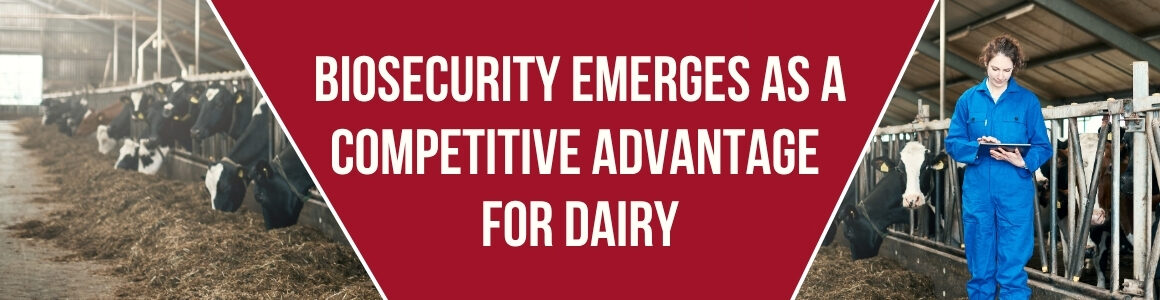
Biosecurity Emerges As A Competitive Advantage For Dairy
HART Insight Summary
New research from Farm Journal and insights from the 2026 Alltech Agri-Food Outlook suggest that biosecurity is becoming a critical business priority for dairy producers. While global dairy feed demand continues to grow, disease threats, supply chain disruptions, and trade restrictions are reshaping how the industry defines success. The findings reveal significant gaps in on-farm biosecurity practices, even as producers face emerging threats such as H5N1 and the resurgence of New World screwworm. Industry experts increasingly view resilience, supported by stronger biosecurity protocols and data-driven decision-making, as essential for maintaining productivity and market access.
Key Takeaways
- Global dairy growth is increasingly influenced by disease risks and supply chain resilience rather than production volume alone.
- Farm Journal research found many dairy operations have biosecurity plans, but regular review and implementation remain inconsistent.
- Physical security gaps, including unrestricted barn and feed access, continue to create vulnerabilities.
- New biological threats such as New World screwworm demonstrate how quickly disease events can disrupt trade and livestock movement.
- Data, AI, and real-time monitoring are becoming important tools for identifying risks and improving herd protection.
At A Glance
- Estimated Reading Time: 4 minutes
- Original Publish Date: June 2026
- Source: Dairy Herd
Data from Farm Journal highlights the critical aspects of biosecurity that producers must address to defend against mounting biological and trade threats.
The global agri-food industry has reached a pivotal crossroads. According to the 2026 Alltech Agri-Food Outlook, the era of predictable, linear growth is over. While global feed production rose to 1.44 billion metric tons in 2025, a 2.9% year-on-year increase, the report notes “the defining characteristic of 2025 was, therefore, not volume alone, but resilience under pressure.”
For the dairy sector, this global volatility is hitting home in a specific, high-stakes way: biosecurity.
A Global Shift: From Volume To Resilience
The Alltech report highlights while North American feed tonnage contracted slightly (0.7%), the dairy sector remained a bright spot, with demand for dairy feed increasing by 0.9%. However, this growth is being tested by permanent influences on profit and loss, most notably, endemic disease.
“Major animal disease outbreaks are no longer isolated or easy to eradicate; they are endemic challenges that can dictate supply chain economics and international trade flows,” the Alltech report states.
As a result, the industry is shifting its focus: “Success will increasingly be defined not by producing more, but by producing profitable, resilient volume.”
The Vulnerability Gap: Farm Journal Research
While the global strategy pivots toward trade resilience and regional zoning, recent Farm Journal research presented at the 2025 Milk Business Conference in Las Vegas, Nev., exposes a critical weakness at the farm level.
The data suggest there is a long way to go. While 68% of dairy farmers with at least 250 cows reported having a biosecurity plan, 34% admitted they do not review those plans regularly. Furthermore, the research identified physical security gaps that could prove costly: More than 20% of surveyed dairies neglected to secure access to barns, and 38% failed to limit access to areas where feed is stored.
This is a notable vulnerability due to the possible exposure to birds and other wildlife in addition to human contact. Visitor access monitoring is also a blind spot for 16% of producers, and only 33% of producers use camera surveillance to oversee their facilities.
“We need biosecurity efforts to be more impactful at the ground level. Not only to prevent major outbreaks, but to even protect employees and families from the things being taken home every day,” says Kirk Ramsey, Neogen’s professional services veterinarian who reviewed the biosecurity survey results.
The Screwworm Warning: A New Kind Of Threat
The urgency for enhanced farm-level security is underscored by the sudden resurgence of biological threats once thought to be under control. The Alltech report highlights the 2025 outbreak of New World screwworm (NWS) in the U.S.-Mexico corridor as a primary disruptor. Last week, a case of NWS was confirmed in South Texas near La Pryor, according to USDA. The sample from a 3-week-old calf umbilical lesion was tested at USDA’s National Veterinary Services Laboratories in Ames, lowa. USDA reports personnel have been activated on the ground. This vector-borne threat caught health authorities off-guard and triggered an immediate halt to live livestock imports, sending shockwaves through the North American cattle cycle. For the dairy producer, the NWS crisis serves as a stark reminder that a biosecurity plan must be dynamic enough to address not just “the usual suspects,” but also the sudden return of legacy pathogens that can shut down international borders overnight.
Expert Insight: Closing The Implementation Gap
Derek Nolan, dairy education and extension specialist with the University of Illinois, Urbana-Champaign, points to a specific area of vulnerability: animal movement.
“Before you purchase animals, have a vet-to-vet conversation,” Nolan advises. “Inquire about animal testing and herd-level tests … review physical health, milk quality and past health records.”
This expert advice aligns with the National Milk Producers Federation’s (NMPF) perspective, which notes that while the industry has made strides through programs like FARM (Farmers Assuring Responsible Management), enhanced biosecurity measures have been instrumental in managing outbreaks and must be continuously updated to meet new threats like H5N1.
2026: Data As A Defense
As we look toward 2026, the ability to prove a farm is “disease-free” will be the difference between maintaining market access and facing devastating losses. The Alltech report suggests technology will be the primary tool for this defense, noting “data has become the sector’s most valuable non-biological asset, providing actionable insights that … effectively optimize the producer’s entire value chain.”
Producers who use AI and real-time monitoring to defend their herds against biological threats will be the ones who thrive in an environment where just-in-time efficiency has been replaced by just-in-case resilience.
The Path Forward
To align with the global shift toward a more secure supply chain, the 2026 outlook suggests three non-negotiables:
Risk Management: Moving biosecurity from a to-do list to a core business strategy.
Operational Efficiency: Using data to identify health risks before they become outbreaks.
Resilience as a Differentiator: Recognizing that, as Alltech puts it, “the ability to supply protein profitably is being tested.”
The era of dairy farming as a purely volume-driven enterprise is fading. In its place is a high-stakes landscape where the most successful producers are those who treat biosecurity as a strategic asset rather than a regulatory burden. As the Alltech and Farm Journal data suggests, the industry’s new normal is defined by a shift from a culture of compliance to a culture of competitive resilience. By closing the physical and digital gaps in their operations today, producers are doing more than just protecting their herds from the next outbreak, they are securing their standing in a global protein market that now demands proof of protection as the price of admission.
HART Perspective
While biosecurity is often viewed through the lens of animal health, its impact extends throughout the dairy supply chain. Disease outbreaks and livestock movement restrictions can affect milk availability, processing schedules, labor planning, and market stability. As dairy operations continue investing in automation, data collection, and operational efficiency, biosecurity increasingly becomes part of a broader risk-management strategy.
For processors, resilient supply chains depend on healthy herds and reliable milk production. The growing emphasis on monitoring, traceability, and proactive risk mitigation reflects a wider industry shift toward protecting production continuity in an environment where biological threats can have far-reaching economic consequences.
What This Means For Dairy & Cheese Processors
- Biosecurity challenges can influence milk supply reliability and long-term production planning.
- Disease outbreaks and trade restrictions may create downstream impacts throughout the dairy processing sector.
- Data-driven monitoring and traceability systems are becoming increasingly valuable across the dairy supply chain.
- Stronger risk-management practices help support operational continuity and supply chain resilience.
- Collaboration between producers and processors will remain important as new biological threats emerge.
Attribution
This article references industry reporting and data originally published by Dairy Herd. HART Design & Manufacturing has added independent analysis and dairy-processing context. The original publishers did not contribute to or review these additions.
Keep Up To Date On Cheese Industry News
Find all of HART Design & Manufacturing’s current industry news here.