Smart Labels Can Save American Households Hundreds Of Dollars A Year
HART Insight Summary
Food packaging continues to evolve beyond traditional labeling, with dynamic freshness indicators emerging as a tool to help reduce food waste and improve transparency. By providing real-time information about product freshness rather than relying solely on printed date labels, these technologies may help processors, retailers, and consumers make more informed decisions while supporting product quality and sustainability throughout the supply chain.
Key Takeaways
- Dynamic freshness labels monitor actual product conditions rather than relying solely on estimated shelf-life dates.
- Smart packaging technologies have the potential to reduce unnecessary food waste while maintaining food safety.
- Consumer education will be essential to ensure these technologies are properly understood and adopted.
- Packaging innovation continues to play an increasingly important role in quality assurance, traceability, and sustainability initiatives across the food industry.
At A Glance
- Estimated Reading Time: 5 minutes
- Original Publish Date: July 2026
- Source: Packaging Digest
Food waste is a growing global problem, with billions of pounds of edible food discarded every year by households, retailers, and food manufacturers. A major contributor is confusion over traditional expiration-date labels that lead consumers to throw away products that are still safe to eat.
Dynamic food labels that alert consumers by reacting to changes in temperature, quality, or spoilage in real time provide an alternative that can help keep more edible food on our plates and send less to our landfills. But do dynamic labels have a consumer-facing place at retail?
Consumer Attitudes On Food Waste
Americans throw away an average of $728 of edible food per year, according to the US Environmental Protection Agency (EPA). While food waste occurs at every stage of the supply chain, a surprising amount happens in homes, where consumers frequently discard food based on static “best by” dates rather than evidence of spoilage.
To investigate how much Americans could save by reducing food waste, NetCredit combined EPA figures with population and household size data from across the country and put a total on each region’s potential wastage. They surveyed 2,000 consumers to find out what they believe about food warning labels and which foods they’re throwing away.
- 88% of Gen Z wrongly believe that food label dates can indicate when the food can be safely consumed. The number of Millennials (78%) who are wrong about labeling is similar to that of Gen X (76%), although Millennials discard significantly more food.
- Gen Z throws away the most–around 31% on average. Millennials aren’t far behind, discarding 26% of the food they buy. Boomers and the Silent Generation each throw out less than 10%.
- Among the food they buy, average Americans throw out 22.7% of their bread, 22.6% of their Lettuce, and 22.4% of their milk (22.4%). Chicken (21.3%) is the leading meat to get chucked, while pork (16.4%) fares relatively well.
Best By, Sell By, Use By?
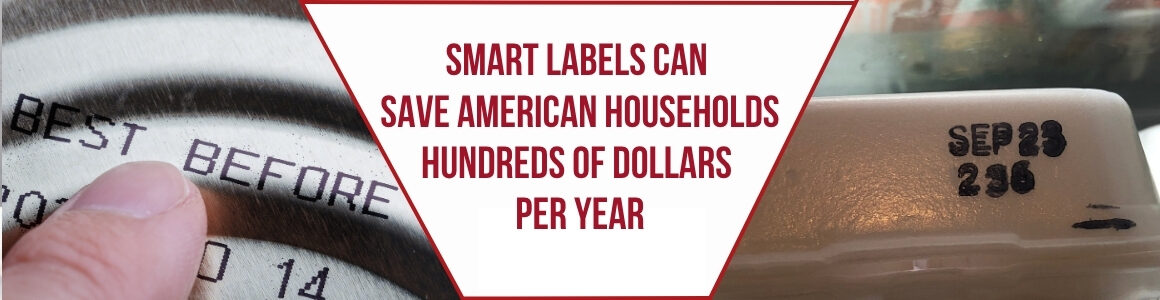
One component of the food waste problem is a consumer disconnect in differentiating between the “best by,” “sell by,” and “use by” terminology on these labels, which consumers often misinterpret as strict indicators of safety rather than quality. According to the USDA:
- Best by: Indicates when a product will be at its peak flavor or quality. It is not a safety or purchase date; food is usually safe to eat after this date, though it may lose texture or taste.
- Sell by: A stock management tool for retailers. It tells the store how long to display the product. It leaves a generous buffer for consumer use.
- Use by: The last date recommended for the consumer to eat the product at peak quality. Except for infant formula, this is still primarily a quality label, though it deserves closer attention on highly perishable goods.
Three Dynamic Label Technology Examples
Dynamic food labels promise a smarter approach, using technology to bridge the gap between estimated expiration dates and the actual condition of the food we eat.
Although they aren’t as cost-effective as static date labels, the following are three examples of innovations designed to help reduce food waste and improve food safety:
Example 1: Bump, from UK startup Mimica, is a tactile label that physically becomes bumpy when food spoils. Instead of relying on a printed date, it responds to actual temperature conditions and spoilage rates. The company says brands can safely extend shelf life while giving consumers a more accurate freshness signal.
Example 2: FreshTag from Scottish packaging company Insignia Technologies is a smart label that indicates freshness by changing color over time by reacting to actual storage temperatures.
Example 3: Timestrip’s electronic temperature and time indicators are externally affixed to the package and are common in foodservice and supply chain uses to show remaining usable life. The latest version, Neo Multi, is reusable.
Balancing The Costs Of Waste vs. Labels
Dynamic labels represent major advances in freshness because they reflect actual product conditions rather than fixed shelf-life estimates. However, the success of consumer-facing dynamic freshness indicators will depend on improving consumer understanding, least they inadvertently contribute to the food waste they are intended to reduce.
Consider this: if shoppers interpret changes in a label’s color or texture as an immediate sign that food is unsafe, rather than a gradual indication of declining freshness, they may throw away products sooner than necessary. What’s more, if shoppers lose confidence in products that show any sign of freshness decline, retailers could see higher rates of returns, markdowns, and premature disposal throughout the supply chain.
But that’s not to say dynamic freshness indicators shouldn’t occupy a viable space in the retail sector.
China’s Success vs. US Challenges
“Historically, retailers have been resistant to consumer-facing technology because consumers tend to select the freshest product and leave older product behind,” comments Claire Koelsch Sand, Owner, Packaging Technology and Research, LLC. “However, when paired with discount coupons to incentivize purchase of less-fresh products, these technologies perform well. Hema in China has been successfully doing this for over five years.”
The other issue is whether retailers and brands can achieve a cost balance with these technologies in comparison to the cost associated with food waste. Sand acknowledges that it depends on the category — for meat and fish, yes. For produce, rarely, she says.
Packaging Technology and Research measured this impact by category for ReFED, a food waste nonprofit working to reduce food waste in the US. ReFED used the research to develop a publicly available, searchable database to define impacts.
With clear communication and standardized labeling, these dynamic labels are uniquely positioned to help consumers distinguish between declining quality and genuine spoilage, reducing waste while maintaining food safety, but challenges remain.
HART Perspective
Packaging is an extension of the manufacturing process, helping preserve product quality long after production is complete. As technologies such as dynamic freshness indicators continue to develop, dairy processors may have new opportunities to support shelf-life optimization, reduce product waste, and strengthen consumer confidence. Successfully implementing these innovations will require thoughtful integration with existing production, packaging, and quality assurance systems.
What This Means For Dairy & Cheese Plants
- Shelf-Life Management: Advanced packaging technologies may help improve freshness monitoring and reduce unnecessary product waste.
- Quality Assurance: Real-time freshness indicators can complement existing food safety and quality control practices.
- Operational Integration: New packaging solutions should work seamlessly with production, packaging, and traceability processes.
- Sustainability: Reducing avoidable food waste supports both environmental goals and operational efficiency across the dairy supply chain.
Attribution
This summary is based on industry reporting originally published by Packaging Digest. HART Design & Manufacturing has added independent analysis and dairy-processing context. The original publisher did not contribute to or review these additions.
Keep Up To Date On Cheese Industry News
Find all of HART Design & Manufacturing’s current industry news here.